Bridging the gap between academic research and real-world solutions
In the pursuit of scientific advancement, the journey from theoretical research to tangible solutions is often fraught with challenges.

Written by
Joshua Ashton
Insight
30 Sept 2026
4 min read
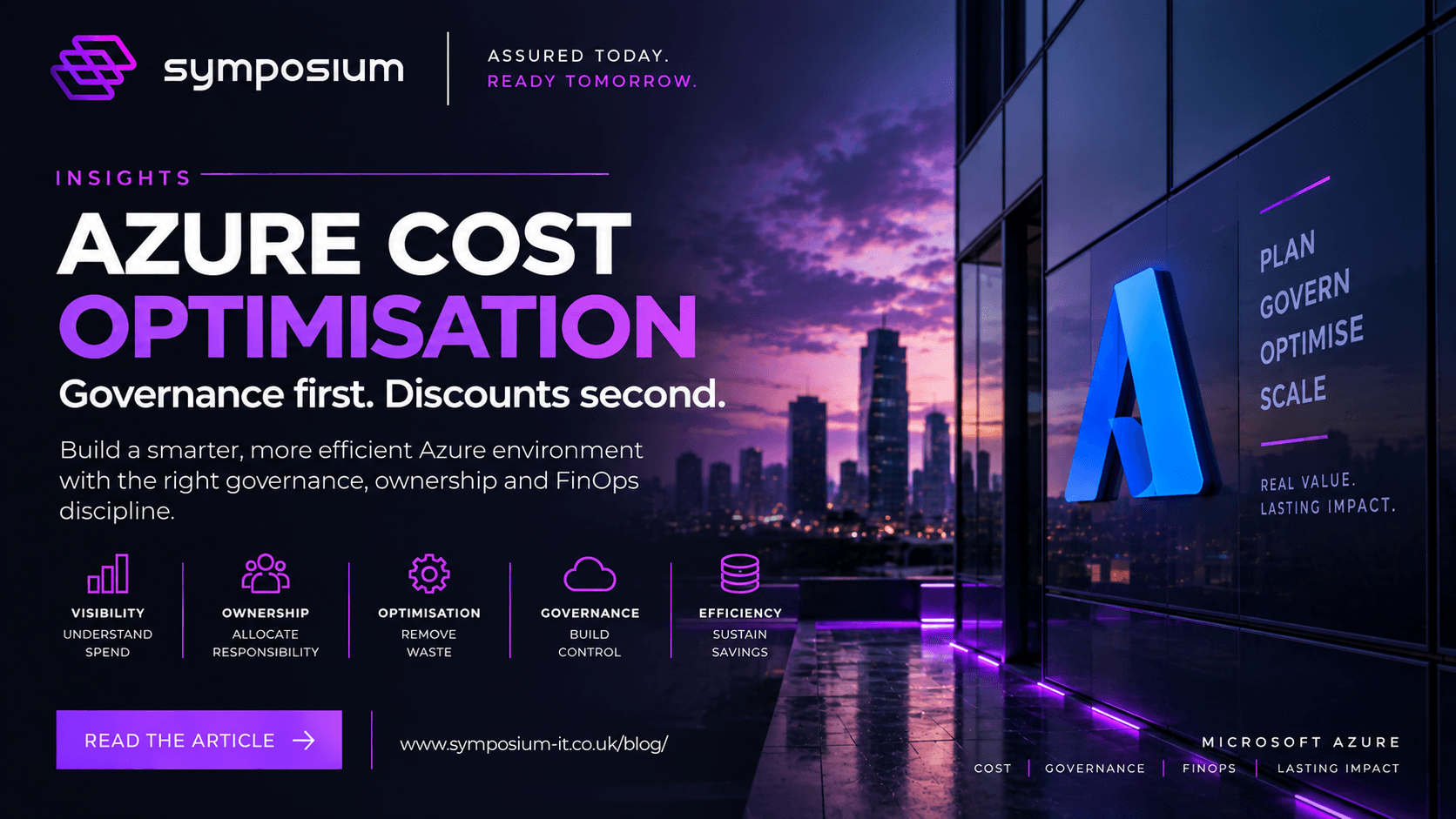
Azure Cost Optimisation Starts with Governance, Not Discounts
When organisations look at reducing their Azure bill, the conversation often starts in the wrong place.
Reservations.
Savings Plans.
Licensing discounts.
Committed spend.
All of those can be valuable, but they address the price of consuming Azure.
They do not necessarily address whether you should be consuming those resources in the first place.
A poorly governed Azure environment can contain oversized workloads, forgotten resources, unnecessary storage, duplicate services, unclear ownership and infrastructure that nobody is comfortable switching off.
Applying a discount to that environment simply makes inefficient cloud consumption slightly cheaper.
The better starting point is:
Governance first. Optimisation second. Commitment third.
That distinction matters because sustainable Azure cost optimisation is not primarily a procurement exercise.
It is an operational discipline.
Why Azure costs become difficult to control
Cloud changes the economics of technology.
In a traditional infrastructure environment, purchasing additional capacity normally involved a deliberate procurement process.
Someone requested hardware.
Someone approved it.
Someone paid for it.
Someone installed it.
Azure removes much of that friction — intentionally.
A new resource can be provisioned in minutes.
That speed is one of the cloud's greatest strengths, but without appropriate governance it can also create cost problems remarkably quickly.
Over time, environments can accumulate:
virtual machines that are larger than necessary;
development resources running outside working hours;
disks left behind after virtual machines are removed;
old snapshots and backups;
public IP addresses no longer associated with active workloads;
redundant application infrastructure;
duplicate test environments;
oversized databases;
excessive log retention;
storage using inappropriate performance tiers;
resources with no clear business owner;
subscriptions with inconsistent tagging;
workloads that nobody wants to delete because nobody knows what they do.
None of these issues is solved simply by buying a Reservation.
They are symptoms of a wider governance problem.
Cost optimisation and cost reduction are not the same thing
There is an important difference between cutting cloud costs and optimising cloud costs.
Reducing cost without understanding a workload can introduce availability, performance or security problems.
Turning off infrastructure indiscriminately is not FinOps.
Neither is downsizing every virtual machine until users complain.
Good optimisation asks a different question:
Are we receiving appropriate business value from what we are consuming?
For some workloads, spending more may be entirely justified.
A production system might deliberately have additional capacity to meet resilience or performance requirements.
Security monitoring creates cost but may materially reduce organisational risk.
Geo-redundant infrastructure may be essential for a critical service.
The objective is therefore not necessarily the lowest possible Azure bill.
It is to remove unnecessary spend while ensuring the environment remains aligned with business, technical, security and resilience requirements.
Start by understanding where the money is going
Before changing anything, organisations need visibility.
That sounds obvious, but it is surprisingly common to find Azure environments where finance knows the monthly invoice while technology teams struggle to explain exactly which workloads generated it.
Azure Cost Management can provide analysis across subscriptions, resource groups and services, while budgets and cost alerts can help organisations detect overspend and unexpected changes. Microsoft also recommends using tags and tag inheritance to improve cost allocation and ownership visibility. Microsoft Learn
At a minimum, an organisation should be able to answer:
What are our highest-cost services?
Which workloads have grown fastest?
Which business unit owns each major workload?
Which resources belong to production, development and test?
What is our expected monthly baseline?
Where are the unexplained increases?
Which costs can be allocated to an application, customer or service?
Which resources have no identifiable owner?
If those questions cannot be answered reliably, cost optimisation becomes guesswork.
Ownership is one of the most important FinOps controls
A cloud resource without an owner is difficult to optimise.
Someone needs to understand:
What is this resource for?
Is it still required?
What happens if we change it?
Who approves its cost?
Tagging can help provide that context.
A sensible tagging model might include information such as:
application;
environment;
business owner;
technical owner;
cost centre;
service;
criticality;
data classification.
The exact taxonomy matters less than consistency.
Microsoft's Cloud Adoption Framework specifically recommends designing tags around an organisation's cost and recharging model so that cloud spend can be tracked effectively. Microsoft Learn
But tagging should not become an administrative exercise for its own sake.
The point is to create accountability.
If a £2,000-per-month resource suddenly appears, the organisation should be able to establish quickly who owns it, why it exists and whether the expenditure is expected.
Governance should make the right thing the easy thing
Strong Azure governance should not rely on someone manually policing every deployment.
Where possible, guardrails should be built into the platform.
That can include:
management group and subscription structures;
Azure Policy;
standardised landing zones;
role-based access control;
naming conventions;
mandatory tagging;
approved regions;
approved resource types;
restrictions on inappropriate SKUs;
budgets and alerts;
infrastructure-as-code;
standard deployment patterns.
This is where cost management and cloud architecture begin to converge.
A well-designed Azure Landing Zone is not simply a security architecture.
It creates a repeatable operating model for how cloud resources are organised, deployed, governed and managed.
FinOps becomes considerably easier when those foundations already exist.
Find the waste before buying the discount
Once visibility and ownership are established, the next stage is usage optimisation.
Look for resources that are:
Idle
They exist, but appear to perform little or no useful work.
Underutilised
They are necessary, but significantly over-provisioned for their actual demand.
Orphaned
They remain after the workload that created them has been removed or changed.
Duplicated
Two or more services are performing substantially the same function unnecessarily.
Poorly scheduled
Development, testing or temporary workloads operate continuously despite only being required for part of the day or week.
Azure Advisor can identify various forms of underutilisation and produce recommendations such as shutting down or resizing virtual machines and VM scale sets. Microsoft Learn
But recommendations should still be reviewed in the context of the workload.
Low CPU utilisation alone does not prove that a server is oversized.
Memory, disk throughput, network patterns, resilience requirements and application behaviour may tell a different story.
Optimisation needs technical judgement.
Rightsize before committing
This is one of the most important principles in Azure cost optimisation.
Imagine an organisation has an oversized virtual machine costing considerably more than necessary.
It then purchases a long-term commitment against that usage.
The organisation has successfully achieved a lower unit price.
But it may also have committed itself to paying for consumption that should have been removed first.
Microsoft's own guidance recommends considering optimisation in this order:
rightsizing or shutting down unnecessary resources first, Reservations afterwards, and Savings Plans subsequently where appropriate. Changes to usage can alter the commitment recommendations Azure generates. Microsoft Learn
That sequence is logical.
First determine what you genuinely need.
Then optimise the price of the remaining consumption.
Reservations and Savings Plans still matter
Once an environment has been cleaned up and baseline demand is understood, commercial optimisation becomes extremely valuable.
Depending on the workload, organisations can consider mechanisms such as:
Azure Reservations;
Azure Savings Plans for Compute;
Azure Hybrid Benefit;
appropriate licensing arrangements;
storage tier optimisation.
The important word is appropriate.
Stable, predictable workloads may suit commitment-based discounts very well.
More dynamic environments might require greater flexibility.
Savings Plan recommendations, for example, are generated using historical usage and cost patterns and model potential commitment levels against that consumption. Microsoft Learn
Historical usage, however, should not replace future planning.
Before committing, ask:
Is this workload expected to remain?
Is its architecture likely to change?
Are we migrating or consolidating systems?
Is usage seasonal?
Are there upcoming projects that materially change demand?
Have we rightsized the environment first?
Do we understand existing commitments and their utilisation?
A discount is valuable only when it applies to consumption you genuinely expect to need.
Architecture can be a FinOps decision
Some of the largest cloud optimisation opportunities do not come from cheaper pricing.
They come from changing the architecture.
For example, an organisation might discover that it is operating infrastructure continuously for a workload that could instead scale dynamically.
Or that multiple independent services could be consolidated.
Or that an application architecture originally lifted directly from an on-premises environment is poorly suited to cloud economics.
This is where cost optimisation intersects with the Azure Well-Architected Framework.
Rather than asking only:
“How can we make this resource cheaper?”
It may be better to ask:
“Is this still the right architecture for the requirement?”
Sometimes the answer will be yes.
Sometimes the biggest saving comes from redesigning the workload altogether.
Cost governance should happen before deployment
One of the most effective ways to reduce cloud waste is not to create it.
Before a new workload enters production, teams should understand:
expected monthly cost;
expected consumption pattern;
workload owner;
business owner;
criticality;
required availability;
scaling behaviour;
backup requirements;
monitoring and logging requirements;
retention periods;
expected lifespan.
That creates a baseline.
Once the workload is running, actual expenditure can be compared against what was expected.
Without a baseline, unexpected cloud expenditure is much harder to distinguish from legitimate growth.
FinOps is a continuous process
A one-off cost review can deliver useful savings.
It does not create FinOps maturity.
Azure environments change continuously.
Teams deploy new applications.
Demand changes.
Projects finish.
Developers test new services.
Data grows.
Pricing models change.
Microsoft introduces new capabilities.
Existing resources become obsolete.
An environment that is optimised today can contain significant waste six months later.
That is why mature organisations establish a recurring optimisation cycle.
A practical rhythm might include:
Observe
Understand spend, trends, anomalies and utilisation.
Allocate
Associate expenditure with applications, teams, customers or business units.
Optimise
Remove waste, rightsize resources and review architecture.
Commit
Apply appropriate Reservations, Savings Plans and licensing benefits to stable demand.
Govern
Use policies, budgets, standards and deployment controls to prevent unnecessary expenditure returning.
Review
Repeat the process and measure whether actions actually delivered the expected outcome.
FinOps should become part of normal cloud operations, rather than an emergency exercise undertaken when an invoice becomes uncomfortable.
The warning signs of an Azure governance problem
There are some common indicators that cost issues may be symptoms of something deeper.
For example:
nobody can explain a material proportion of the Azure bill;
resource ownership cannot be determined quickly;
tagging varies substantially between subscriptions;
budgets exist but nobody responds to them;
development environments run continuously;
Reserved Instances or Savings Plans have been purchased without workload review;
resources are deployed manually with little standardisation;
subscriptions have grown organically without a clear management structure;
old projects remain indefinitely because teams are afraid to remove anything;
Azure Advisor contains recommendations that are rarely reviewed;
finance and technology teams discuss cloud expenditure only when the invoice rises.
In those situations, the opportunity is not simply to find a few cheaper resources.
It is to improve the operating model.
A sensible Azure optimisation sequence
For organisations unsure where to begin, the process does not need to be complicated.
1. Establish the baseline
Understand current expenditure and identify significant cost centres.
2. Establish ownership
Determine which applications, teams and business services own the consumption.
3. Review governance
Assess subscriptions, management groups, policies, RBAC, tagging, budgets and deployment standards.
4. Identify waste
Look for idle, orphaned, redundant and unnecessarily persistent resources.
5. Rightsize
Compare resource capacity with actual workload requirements.
6. Review architecture
Determine whether expensive workloads are still designed appropriately for Azure.
7. Optimise commercial rates
Once genuine baseline consumption is understood, assess Reservations, Savings Plans, Hybrid Benefit and other applicable pricing options.
8. Create an ongoing FinOps rhythm
Measure expenditure, review recommendations and continuously improve the environment.
The sequence matters.
You should understand and optimise consumption before committing to paying for it more cheaply.
From cost reduction to cloud governance
The most valuable outcome from a cloud cost review is not necessarily the amount removed from next month's Azure bill.
It is understanding why that unnecessary expenditure existed in the first place.
If a forgotten resource can remain unnoticed for eighteen months, the question is not simply whether it should be deleted.
The better questions are:
Why did nobody know it existed?
Why was there no owner?
Why did no alert identify the spend?
What prevents the same thing happening again?
That is where cost optimisation becomes governance.
And where governance becomes sustainable FinOps.
Understanding your Azure environment
Symposium IT's Smart Cloud Health Check assesses Azure and Microsoft cloud environments across cost, governance, security, architecture and operational maturity.
Rather than simply looking for discounts, we identify inefficient consumption, governance gaps, optimisation opportunities and areas where the environment can be better aligned with Microsoft's Cloud Adoption Framework and Well-Architected Framework.
The objective is not simply to reduce a bill.
It is to understand whether the cloud environment is secure, governed, efficient and fit for what the organisation needs next.
If you want to understand where your Azure expenditure is going — and whether your current environment is operating efficiently — speak to Symposium IT.
Run better. Govern better. Spend deliberately.